Technical Articles

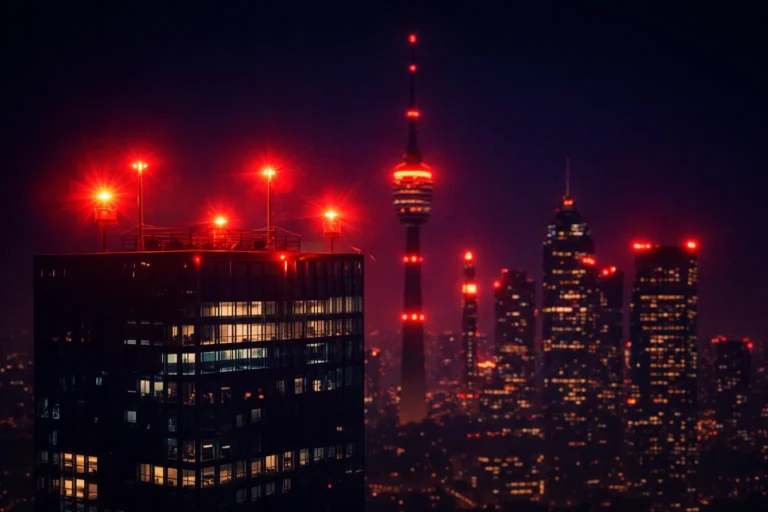
This is the first question most people ask. Intuitively, a steady light seems more visible — it is always on, always there. So why does an obstruction light blink?
The answer lies in how the human eye works. A steady light blends into the visual background over time, especially when surrounded by hundreds of other steady lights across a city skyline. The brain begins to filter it out. A flashing light, by contrast, triggers the eye’s motion-detection system with every pulse, forcing renewed attention each time it fires.
The International Civil Aviation Organization (ICAO) has quantified this in its standards. Under ICAO Annex 14, medium-intensity obstruction lights must flash between 20 and 60 times per minute, and high-intensity lights between 40 and 60 times per minute. These rates were chosen through research into pilot perception — fast enough to be conspicuous, slow enough not to cause visual fatigue or distraction in the cockpit.
A blinking light is not a weaker signal. It is a smarter one — engineered to be impossible to ignore.
The practice of marking tall structures for aviation safety dates back to the early days of commercial flight. As aircraft began flying at night in the 1920s and 1930s, collisions with radio towers, chimneys, and early skyscrapers became a serious concern. Pilots had no radar, no GPS, and often flew in low cloud — relying entirely on visual reference.
The first formal international standards for obstruction lighting were established after the Second World War, when the newly formed International Civil Aviation Organization began harmonising aviation safety rules across member states. The core principle has remained unchanged ever since: any structure that poses a hazard to aircraft must be made visible, day and night.
In China, the current standard — MH/T 6012, issued by the Civil Aviation Administration of China (CAAC) — aligns closely with ICAO Annex 14 and specifies exactly which buildings require lights, what intensity they must emit, and how they must be maintained.
Not every tall building needs an obstruction light. The threshold under Chinese civil aviation regulations is 45 metres above ground or water level. Any structure at or above this height is considered a potential hazard to low-flying aircraft and must be assessed for lighting requirements.
However, height alone does not determine the requirement. A building’s location relative to nearby airports matters just as much. Structures that penetrate an airport’s obstacle limitation surface — an invisible three-dimensional boundary that protects approach and departure paths — may need obstruction lights even if they are shorter than 45 metres. The civil aviation authority makes the final determination on a case-by-case basis.
Once the requirement is established, the intensity of the light is determined by the building’s height:
| Height above ground | Required light type | Colour | Minimum intensity |
|---|---|---|---|
| 45 m – 90 m | Low intensity (Type B) | Red, steady | 32 cd |
| 90 m – 150 m | Medium intensity (Type B) | Red, flashing | 1,600 cd |
| Above 150 m | High intensity (Type A) | White, flashing | 2,000 cd (night) / 200,000 cd (day) |
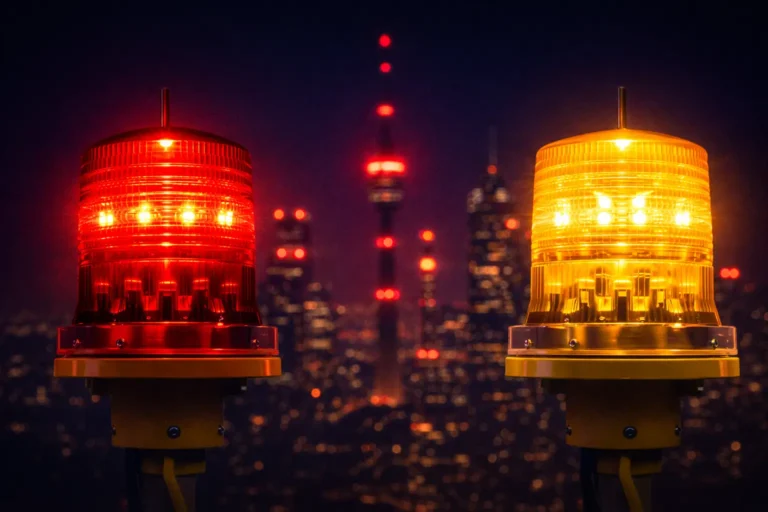
The colour difference is not arbitrary — it encodes altitude information for pilots at a glance.
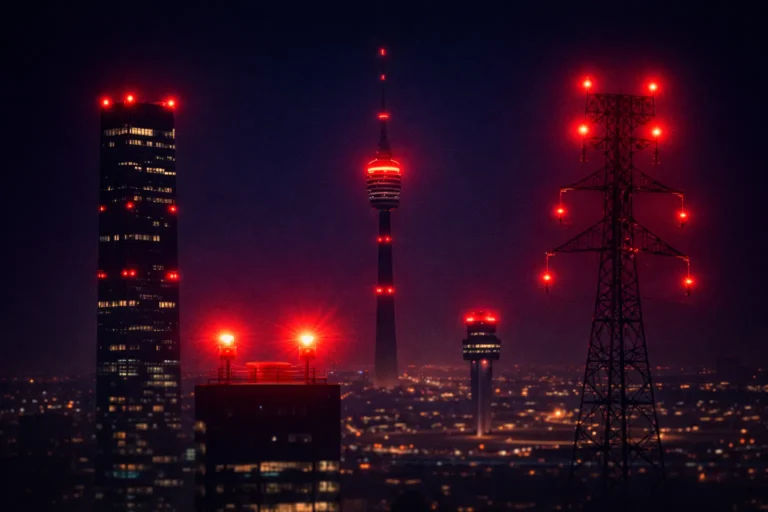
Red lights are used on structures up to 150 metres. Red has a long wavelength and penetrates haze and light pollution well, making it effective for shorter-range warnings in urban environments. It is also less disruptive to residents living nearby.
White lights are required above 150 metres. At extreme heights, white provides superior conspicuity — it can be seen from much greater distances and across a wider range of atmospheric conditions. The trade-off is that white high-intensity lights are significantly brighter and can cause light pollution complaints from residents below. To balance this, ICAO requires that high-intensity lights automatically dim at night:
This automatic dimming system — triggered by a photometric sensor — means the light is always bright enough to be seen from the air, but never brighter than necessary to minimise ground-level impact.
Because most people never think about aviation obstruction lights until they notice one, a number of persistent myths have built up around them.
Antenna indicator lights do exist, but they are typically low-intensity steady lights used for maintenance access. Aviation obstruction lights are a separate, regulated system governed by civil aviation law — not building management or telecommunications regulations. Many buildings have both, serving entirely different purposes.
Aviation obstruction lights flash continuously, every night, every year, regardless of whether anything is wrong. The flashing pattern is fixed by regulation. If the light ever stops flashing, that is actually the problem — a fault that must be reported to the civil aviation authority within 24 hours under Chinese regulations.
Aviation obstruction lighting is a legal requirement, not a voluntary measure. Building developers must obtain civil aviation approval as part of the construction permit process for any qualifying structure. Failure to install compliant lighting — or allowing lights to fall into disrepair — can result in regulatory action. The lights must also be tested for intensity every 12 months.
Yes — and they are already in use, primarily on wind farms where the sheer number of turbines makes constant flashing a significant source of light pollution across rural landscapes.
The technology is called an Aircraft Detection Lighting System (ADLS). Rather than flashing continuously, an ADLS uses radar or transponder-based sensors to detect when an aircraft is within a defined radius. The obstruction lights only activate when an aircraft is actually present — remaining off the rest of the time. Studies in Europe have shown that ADLS reduces the number of hours obstruction lights are active by over 98% in most locations.
ICAO has formally recognised ADLS as an acceptable alternative to continuous flashing in its Annex 14 guidance. Regulators in China are monitoring its adoption, and the technology is beginning to appear in new construction approvals for tall buildings in urban areas where light pollution is a concern.
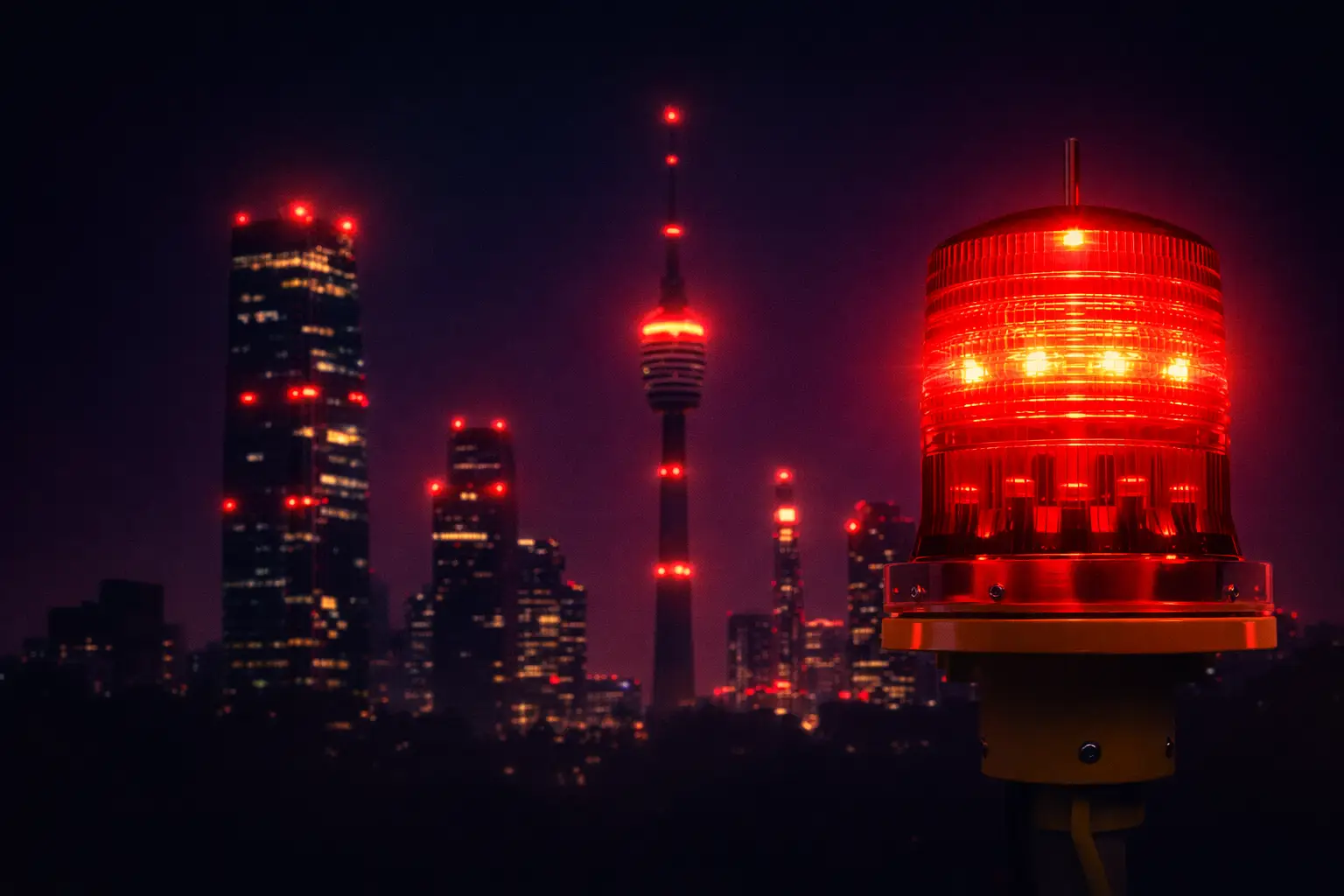
The flashing red or white light you see on top of a tall building is one of the most quietly essential pieces of urban safety infrastructure. It has been blinking through every storm, every fog, and every dark night for decades — unseen by most, and entirely unappreciated. Its job is simple: to make sure that the pilots navigating above your city at night never have to wonder where the buildings are.
Next time you see one, you will know exactly what it is, why it flashes, and why the colour matters. And you might find it a little less easy to ignore.