Technical Articles

A configuration guide for high-rise buildings and infrastructure based on ICAO (International Civil Aviation Organization) and CAAC (Civil Aviation Administration of China) standards.
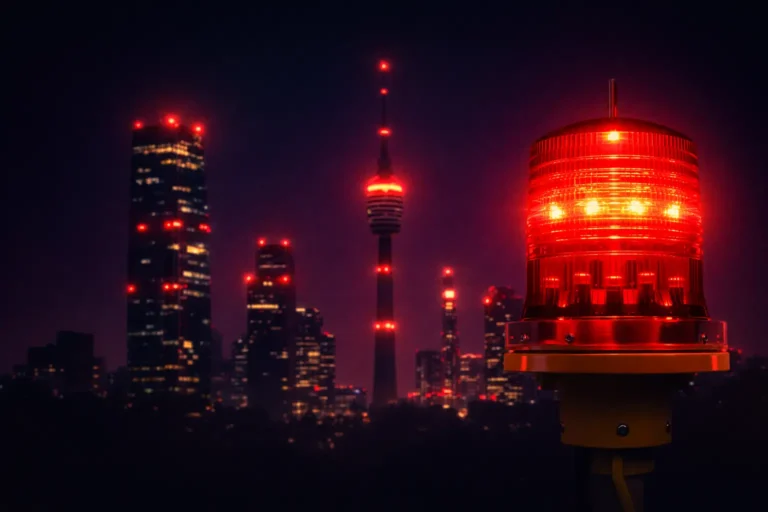
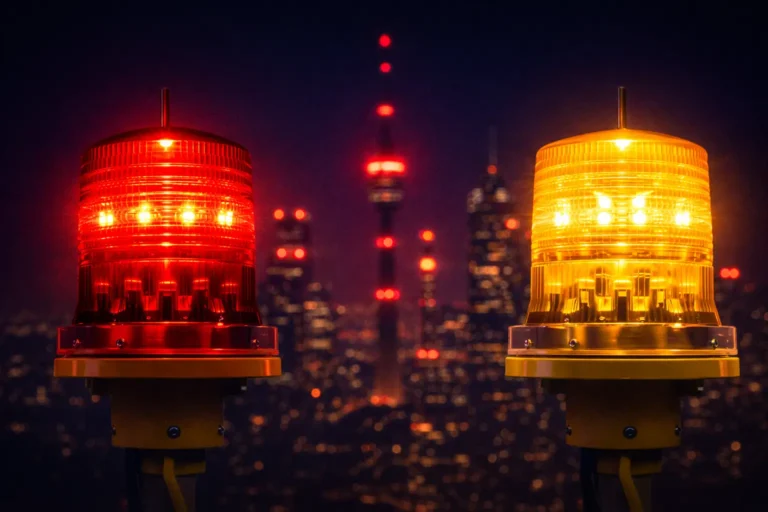
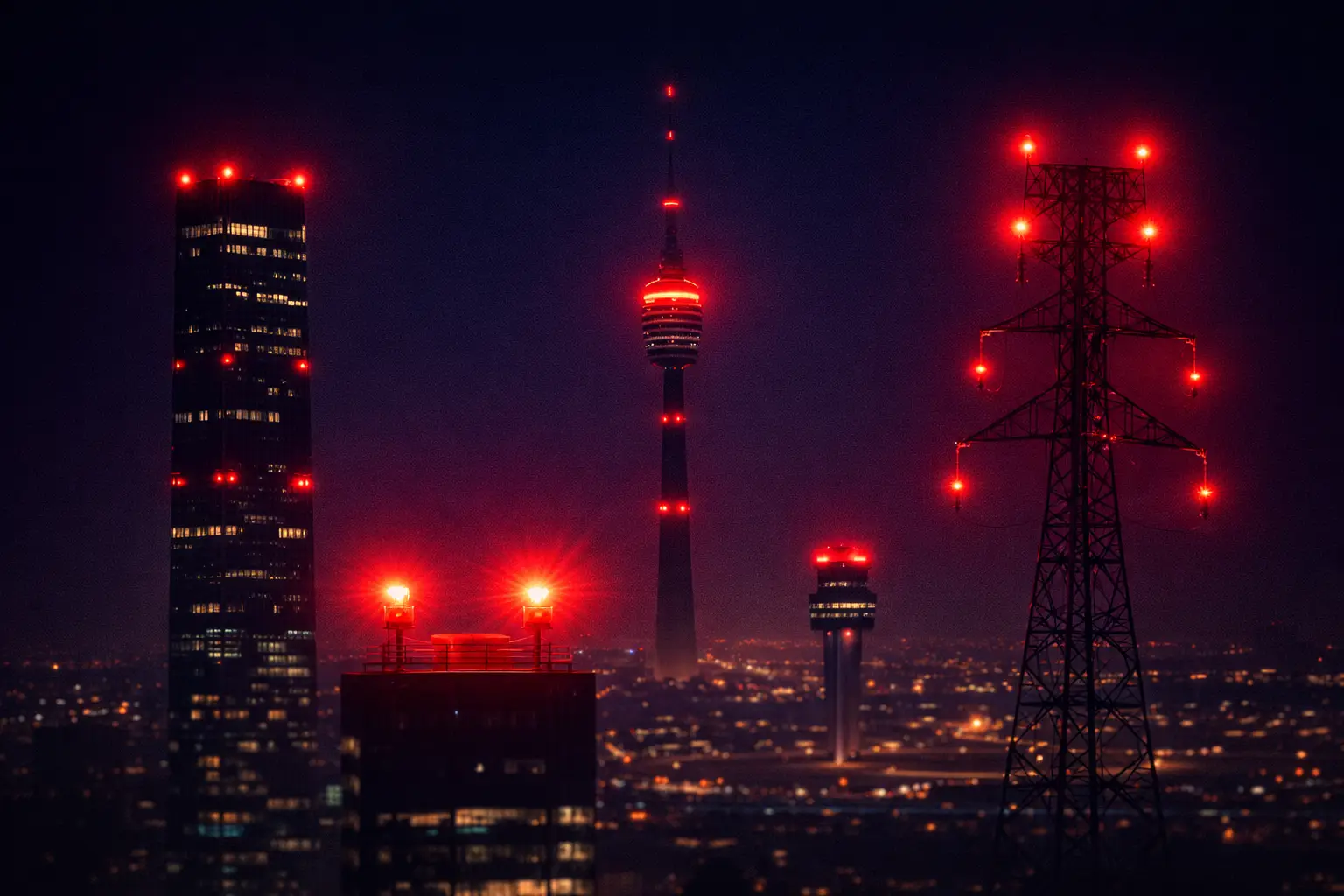
High-rise and super-tall buildings represent the most common application for aviation obstruction lights. Under MH/T 6012, structures between 45 m and 150 m in height must be fitted with medium-intensity red flashing lights (Type B, effective intensity ≥ 1,600 cd). Structures exceeding 150 m require high-intensity white flashing lights with automatic three-level brightness adjustment for daytime, dusk, and night conditions. Super-tall buildings must also install lights at intermediate floors in addition to the rooftop, ensuring full-height visibility from all approach directions.
Industrial chimneys and cooling towers are typically tall and slender, making them easy to overlook during low-altitude flight. Because their top cross-section is small, light fixtures must provide 360° horizontal coverage. Chimney surfaces should also be painted with aviation colour markings (alternating red and white bands) to enhance daytime conspicuity. For cooling tower clusters, the highest point of each tower must be individually lit, and all lights must be synchronised to flash simultaneously.
Large bridges spanning rivers, sea straits, or gorges often have pylons exceeding 150 m, requiring high-intensity white flashing lights. The unique challenge for bridge installations is resistance to corrosion and salt spray, particularly in coastal environments. Luminaires must achieve a minimum ingress protection rating of IP66 and be engineered to withstand strong wind-induced vibration. Obstruction lights must be installed at the pylon tops, intermediate heights, and cable anchorage zones to form a comprehensive three-dimensional marking system.
High-voltage transmission towers run in linear formations across complex terrain — mountains, rivers, and remote areas — making them particularly difficult to detect from the air. ICAO guidelines require priority lighting on the tallest towers along a route and at directional changes, with increased density where lines cross important flight corridors. Given the large number of towers and the difficulty of maintenance, solar-powered aviation obstruction lights are now widely adopted to reduce operational costs, typically paired with wireless remote monitoring systems.
Wind turbines represent one of the fastest-growing application areas for aviation obstruction lights. Their large rotating blade radius and distinctive visual flicker can impair pilots’ ability to judge distance accurately. Both ICAO and the European Union Aviation Safety Agency (EASA) require medium-intensity obstruction lights at turbine nacelle height. Within a wind farm, perimeter turbines and the tallest turbines must be prioritised for marking. Aircraft Detection Lighting Systems (ADLS) — which activate lights only when an aircraft is detected — have become the industry standard, significantly reducing light pollution for surrounding communities.
5G base stations, broadcast transmission towers, and microwave relay towers are numerous and widely distributed. Any such tower exceeding 45 m must carry obstruction lights; those exceeding 150 m must be upgraded to high-intensity fixtures. Given the density of antennas on communication towers, luminaire placement must avoid electromagnetically sensitive zones, using fibre-optic or isolated power supply solutions. If attached equipment — such as dish antennas or mounting booms — increases the effective height of a tower, the obstruction light configuration must be reassessed accordingly.
Construction tower cranes are temporary obstacles, yet they frequently exceed 45 m in height and — when operating in urban centres — can easily penetrate airport approach corridors. China’s civil aviation authority has clear approval requirements for construction cranes: projects near airports must submit a declaration to the civil aviation regulator before work begins. Obstruction lights must be installed at the tip of the jib and at the highest point of the mast, and must remain operational throughout the entire construction period. Once construction is complete, the declaration must be formally cancelled with the civil aviation authority.
Marine beacons serve a dual function — navigational aids for vessels and aviation obstruction markers — and are primarily deployed on offshore platforms, river lighthouses, and port facilities. Solar-integrated aviation lights combine a photovoltaic panel, battery, LED light source, and controller in a single self-contained unit, requiring no external power supply. This makes them particularly well-suited to isolated offshore installations. The light colour and flash rhythm must simultaneously comply with both the International Maritime Organization (IMO) and ICAO standards to prevent signal conflicts between the two systems.